
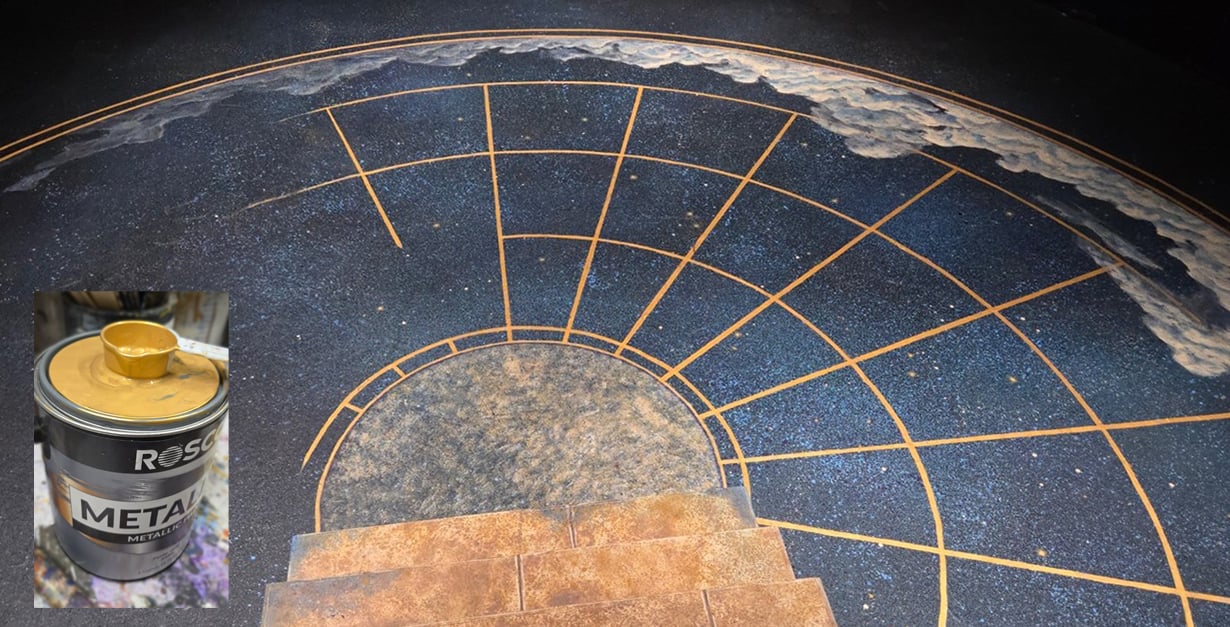
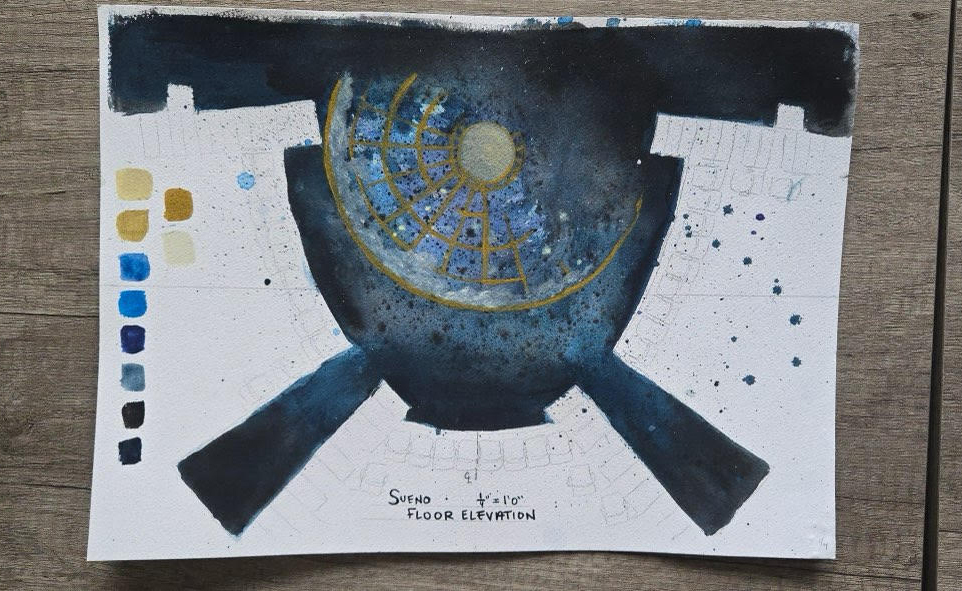
The scenic design for Sueño at West Virginia University was created by first-year MFA student Sophie Pfluger who was inspired by a fractured astronomer’s star chart. The palette featured rich blues, navy, and purples evoking a night sky that was accented by a crisp metallic gold star chart medallion inlay. Because metallic gold was central to the design, we compared Rosco’s scenic metallic paints – including their new Metallix paints – to determine the best option.
The products tested were Rosco Off Broadway Gold and the new Rosco Metallix line. The Off-Broadway Gold, which is made with actual gold flakes, appeared promising in the can but it requires significant stirring to fully incorporate. When applied, it can appear thin and streaky if not thoroughly mixed, and it tends toward a darker, more muted finish. Our experience showed that the Off Broadway Gold performed best when painted on top of a yellow or yellow ochre base with multiple coats. In addition, the metallic flakes will oxidize if Roscoflamex PA flame retardant is added.
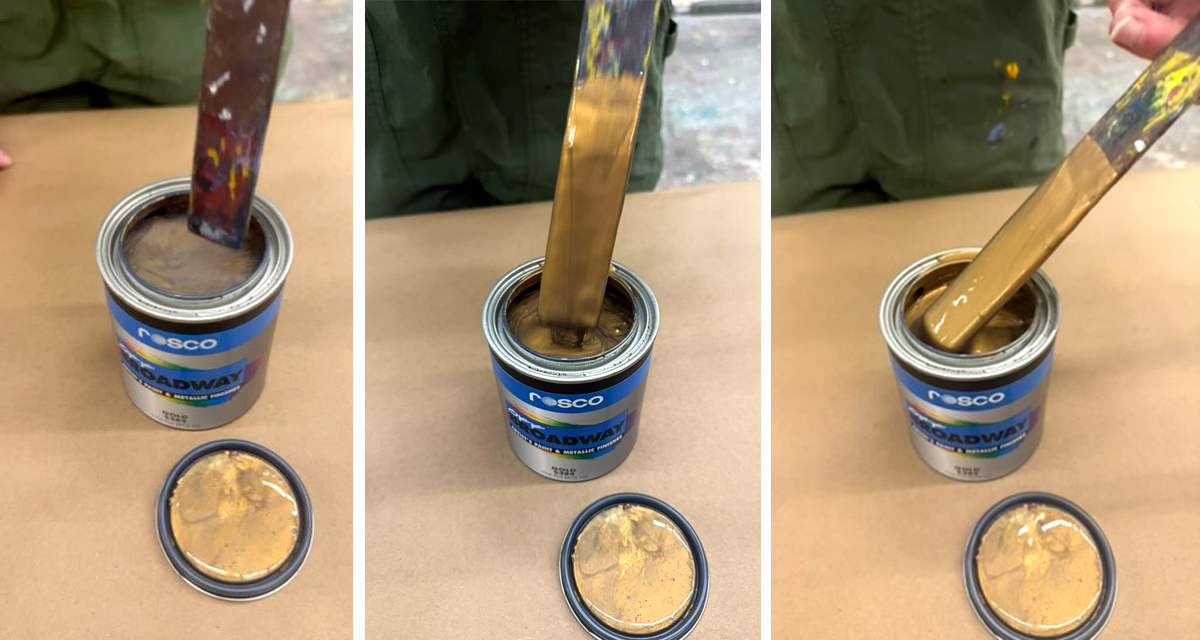 Rosco’s original Off Broadway Gold – can opened (L), stirring (C), and fully stirred (R).
The Metallix line, which is made using mica powder-based pigmentation, stirred more easily to a uniform consistency and produced a more reflective and consistent sheen, as well as an opaque, even coat that was achieved with minimal effort. And, because they are made with mica powders, the Metallix colors won’t tarnish when mixed with the Roscoflamex PA. The range includes six metallic colors: Pyrite Gold, Gilders Gold, Burnished Bronze, Polished Copper, Steel Silver, and Cream Pearl.
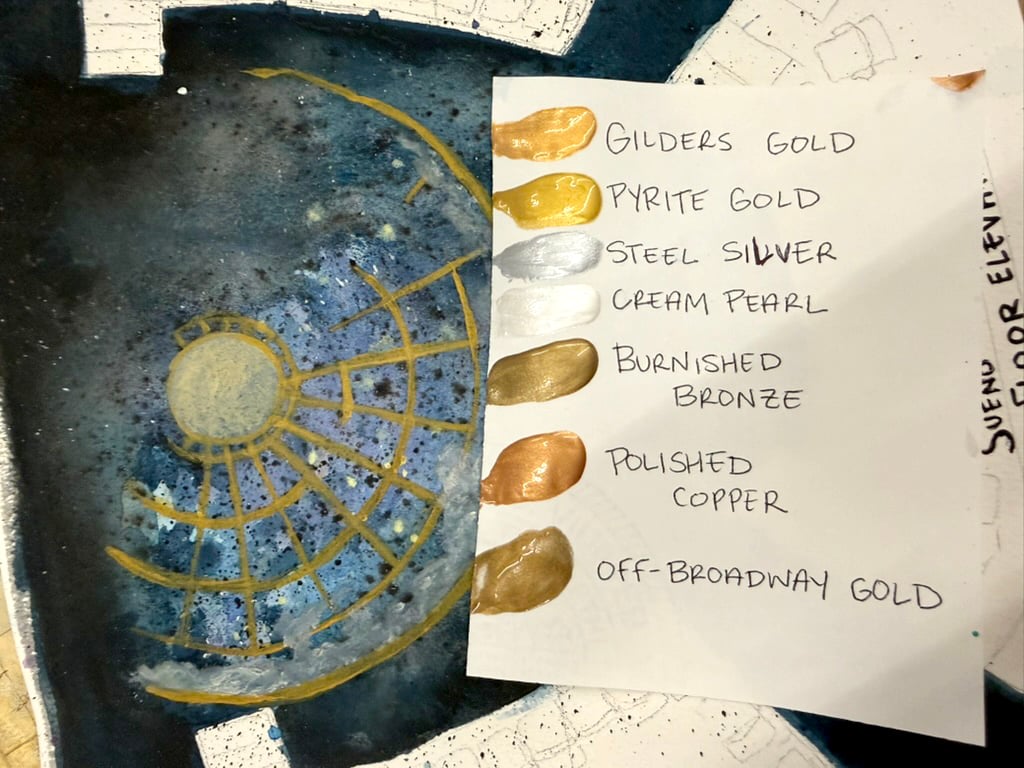
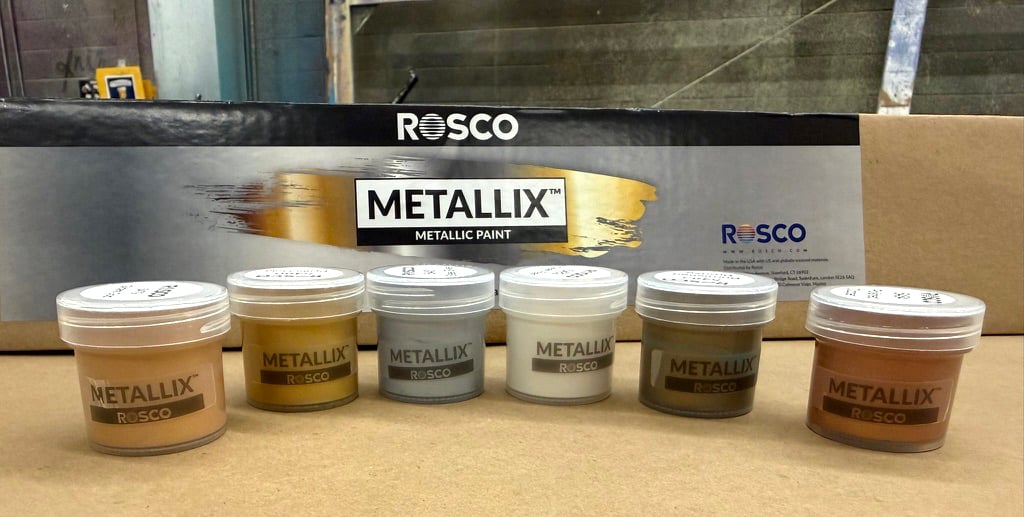 The convenient Metallix Test Kit was used to evaluate the different colors for our design.
After consideration, the Pyrite Gold most closely matched Sophie’s vision. It is a brighter, more vibrant yellow gold than the Off-Broadway Gold was, while the Metallix Gilders Gold leaned warmer with a red undertone.
We applied the Pyrite Gold Metallix straight from the can, diluted it for blending, wet-blended it with other Off-Broadway colors, and we sponged and sprayed it. In each case, the paint maintained coverage and a consistent sheen, often achieving full opacity in a single coat. While the Metallix Pyrite Gold performed well over a mid-tone gray primer, a complementary base such as yellow ochre enhanced its brightness.
The Metallix paints proved especially effective for a range of techniques, including faux finishes, sponging, and sprayed overlays. The vertical fractured arcs on the platforms had a wet blend of straight Pyrite Gold and Off-Broadway Van Dyke Brown to create the base of the faux hammered finish. The highlights and shadows were sponged with more Pyrite Gold, Van Dyke Brown, and a tan color for middle tone – then a fine spray of Pyrite Gold was applied to soften it. We also used some of the Pearl White as highlight touches in the clouds on the floor, which was blended using two methods - a soft brush and finger smudging.
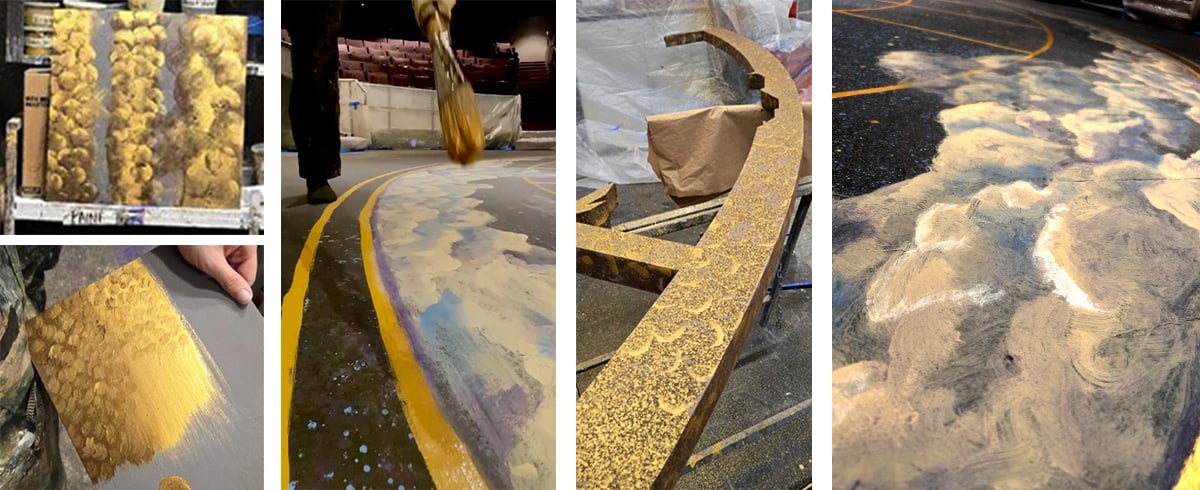
Even when diluted, the Metallix paint retained its reflectivity and blended smoothly to a soft fade, while maintaining a consistent opaqueness and even coverage with its striking Metallix shimmer. As with all paint diluted for a hand pump sprayer, special attention to the viscosity of the paint, the cleanliness of the sprayer, and constant pressurization is key to success.
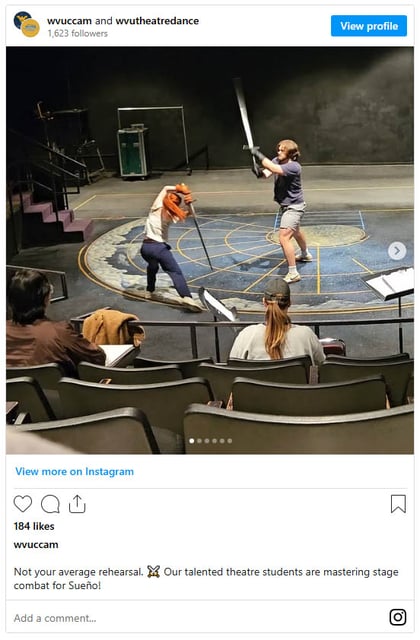 Durability was a major concern, as the deck had to be completed before rehearsals and withstand eight weeks of heavy use — including classes, rehearsals, load-in, and performance. The production also involved sword fighting, blood effects, and heavy boot traffic.
Ultimately, a system of one base coat of Off-Broadway Yellow Ochre, two coats of Pyrite Gold Metallix, and four sprayed coats of Rosco Clear Acrylic Gloss held up well under these conditions. Under stage lighting designed by Alan McEwen, the gold maintained a reflective, even finish.
Watch the video to see the finished floor.
An often-overlooked advantage of paint is its cleanability. Despite the Metallix line’s strong adhesion in application, the paint washed easily from our brushes, containers, and skin with warm water and light scrubbing—an unexpected but welcome benefit! It was the metaphorical cherry atop this already wonderfully shimmery sundae. Paints like this tend to cling to everything it touches — which is a benefit when it is supposed to, but often a hassle when trying to remove it from skin and painting equipment post-use. The Metallix collection stayed where it was supposed to and politely saw itself out when it was time to clean up.
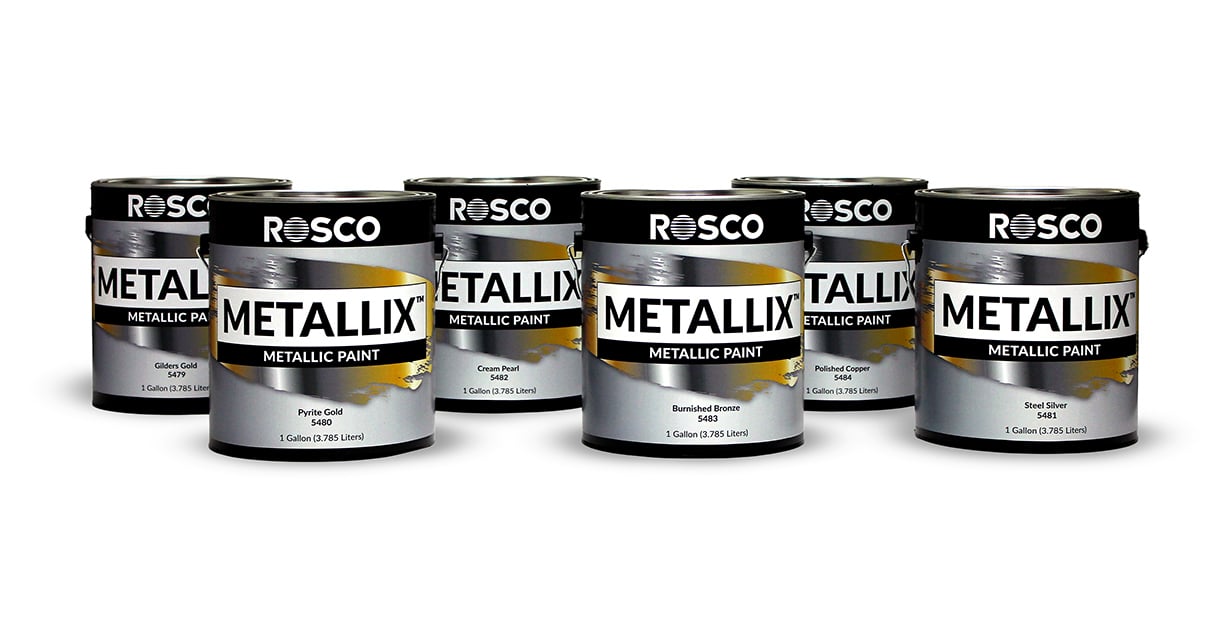 Click the image above or visit www.rosco.com/metallix to learn more about these new metallic
scenic paints.
Overall, this is a glowing recommendation for Rosco’s Metallix line. The entire paint team for WVU’s Sueño will be sharing the news that this paint is worth its weight in gold. If it isn’t the best gold paint, it is definitely one of the top contenders. Based on both application and durability, Pyrite Gold stands out as a top-tier metallic scenic paint. Metallix offers improved consistency, brightness, and ease of use, making it a compelling upgrade for scenic artists.
Sueño Production Team
Director: Shelby Garrett
Scenic Designer: Sophie Pfluger
Charge Artist: Daney Brookover
Lead Scenic Artist: Sarah Kyer
Scenic Artists: Abby Bragg, Maguire Glass, Emily Jack
Props Coordinator: Karlee Klitgaard
Technical Director: Dylann Burmeister
Lighting Designer: Alan McEwen
Projections Designer: Samuel Felinton
Costume Designer: Brendon McCabe
Sound Designer: Will Davis
Stage Manager: T. Knight
This article was written in partnership with Sophie Pfluger, a first-year MFA Scenic Design student at West Virginia University who has spent the last three years freelancing as a Scenic Artist and Designer at the Guthrie Theatre and Minnesota Opera in the Minneapolis/St. Paul area.
Tammy Honesty May 07, 2026 Questions?

Tammy Honesty is an award-winning, USA Local 829 Scenic Designer, a Scenic Artist, an Associate Professor of Scenic Design at West Virginia University, the co-author of The Fake Food Cookbook series, and she is currently serving as Treasurer for USITT. Her work, both as a working scenic and as an educator, gives her license to experiment with new techniques for creating props and scenery - which she often shares here on the Rosco Spectrum blog.